
Should You Start a Literature Review With Search or Structure? Start With the Paper Set
suiceee
If you are writing a literature review, you should not start with the outline.
You should start with the paper set.
That is the short answer. Most weak literature reviews do not fail because the writer is bad at summarizing. They fail because the structure is built too early, before the evidence base is stable enough to support it.
This is where many AI-assisted workflows go wrong. A student opens a blank page, asks an AI tool to produce an outline, and then tries to find papers that fit the generated sections. That feels efficient, but it quietly reverses the logic of academic writing.
In a serious review workflow, structure should come from the literature, not the other way around.
Why starting with the outline creates weak reviews
An early outline feels productive because it gives you shape. It creates the illusion of progress. But in literature review work, shape without source grounding is fragile.
When you outline first, three problems usually follow.
- You force papers into a structure that may not match the field
Once a draft outline exists, people start collecting sources to fill prewritten sections. That means the review is no longer discovering the field. It is defending an initial guess about the field.
This is especially risky in interdisciplinary topics, emerging methods, and fast-moving areas where the real themes are not obvious at the start. - You miss how papers actually cluster
A useful review is not just a stack of summaries. It shows how the literature groups itself:
- by debate
- by method
- by theory
- by population
- by time
- by evidence quality
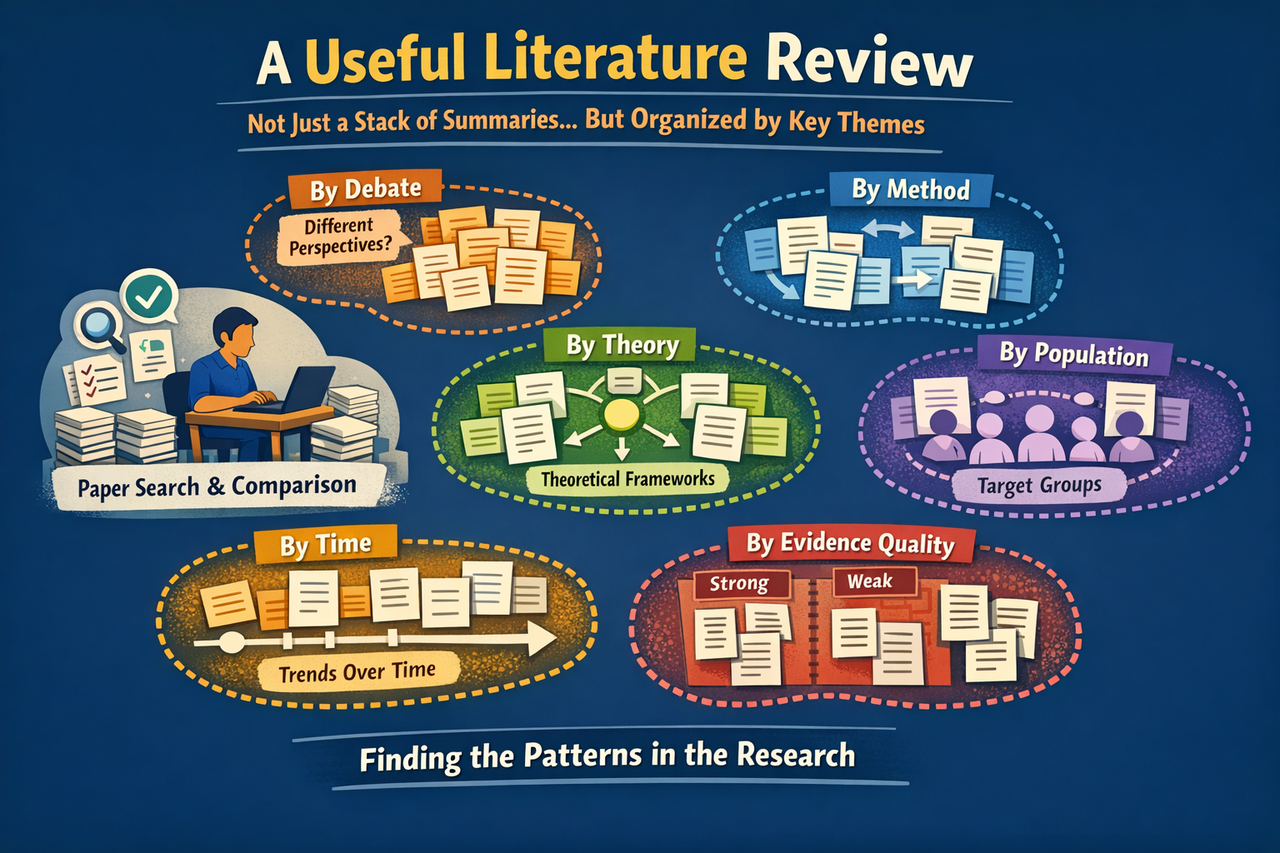
You cannot see those clusters clearly until you have searched, shortlisted, and compared a real paper set.
- AI starts inventing coherence too early
Generic AI tools are very good at producing plausible review structures. The problem is that plausibility is not the same as methodological fit.
An outline can sound academic while being weakly connected to the actual literature. The result is often a review that reads smoothly but has no real evidentiary backbone.
What should come first instead
Start with a scoped paper set.
That does not mean you need to read everything before writing a single heading. It means you need enough real literature in front of you to understand what kind of review you are actually writing.
In practice, that usually means:
- searching across real academic databases
- refining the query until the results stop being noisy
- shortlisting papers that are genuinely relevant
- comparing them for recurring themes, methods, and disagreements
Only after that should you build the review structure.
The structure should emerge from the paper set.
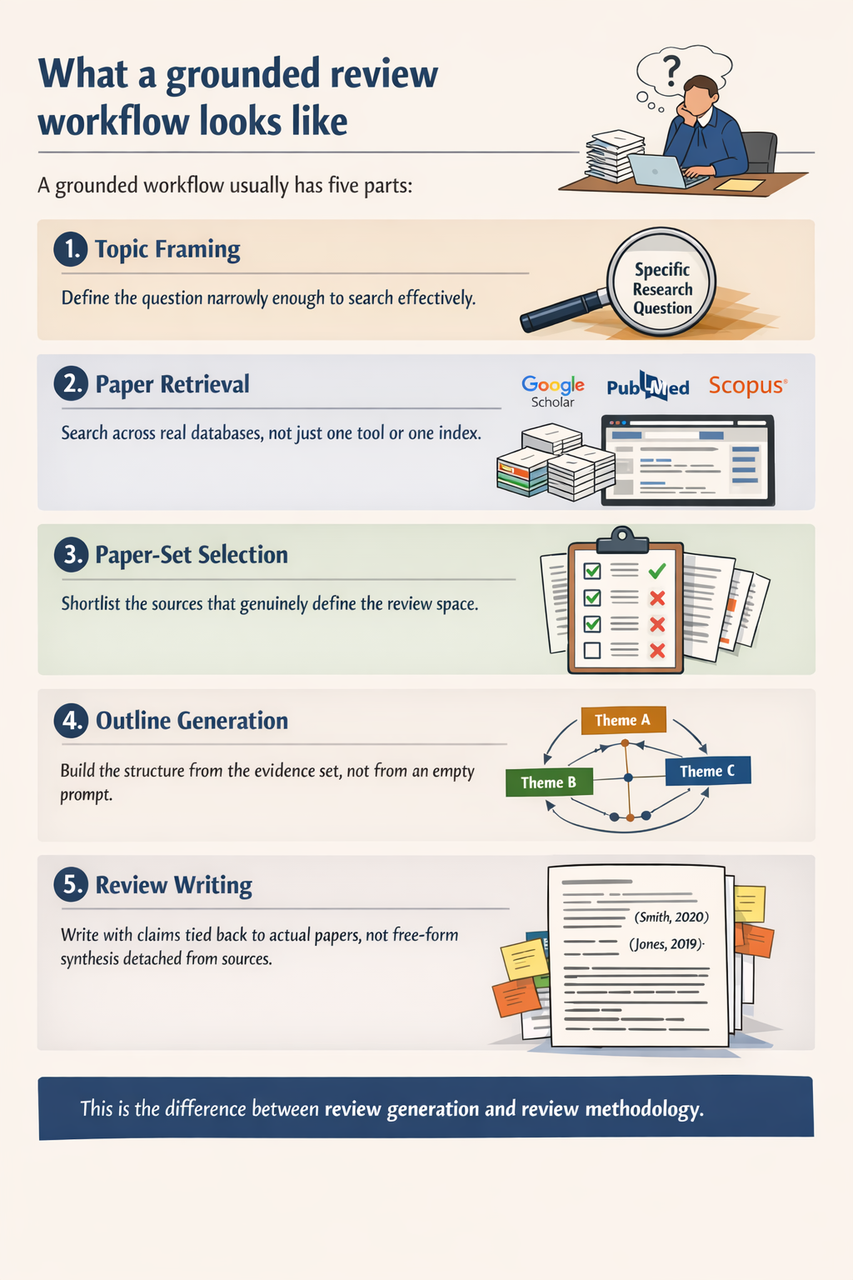
A better workflow: search, shortlist, then outline
If you want a literature review that feels grounded instead of generic, use this sequence.
Step 1: Search broadly enough to map the field
At the start, your goal is not to write. Your goal is to understand the shape of the literature.
You need a search process that does more than retrieve a few convenient results. It should help you test the topic from multiple angles and pull from real academic sources.
This is why multi-database search matters. A topic may look very different in Google Scholar, PubMed, and Semantic Scholar. If you search in only one place, your outline may end up reflecting the bias of the database instead of the field itself.
Step 2: Shortlist a defensible paper set
Once you have results, move from retrieval to selection.
At this stage, ask: - Which papers are central?
- Which papers are recent but already influential?
- Which papers disagree with each other?
- Which papers represent different methods or schools of thought?
- Which papers are only loosely related and should be excluded?
This is where a review starts to become intellectually useful. You are no longer gathering papers just because they exist. You are building a paper set that can actually support synthesis.
Step 3: Let the recurring patterns define the outline
Now look at the paper set as a whole.
Do the papers cluster around methodological differences? Around competing explanations? Around application contexts? Around unresolved limitations?
Those recurring patterns should drive the outline.
That is how you avoid the most common AI-review failure: a clean structure built on weak source logic.
A simple rule worth using
If your outline could have been written before you saw the paper set, it is probably too generic.
That does not mean every heading must be surprising. It means the final structure should reflect what the literature actually does, not just what a general AI writing assistant thinks a review usually looks like.
When it is okay to sketch structure early
There is one important nuance here.
You can start with a provisional structure.
For example, it is reasonable to begin with a rough frame such as: - background
- major themes
- methodological differences
- limitations
- future directions
But that is only a temporary scaffold. It should not be treated as the final outline.
The mistake is not “having any structure early.” The mistake is locking the structure before the paper set has been properly formed.
Why this matters more in AI-assisted writing
AI has made it easier to draft reviews quickly. It has not made it safer to skip methodology.
If anything, the opposite is true. The faster the writing layer becomes, the more important the source layer becomes.
That is why “real-paper-first” is not just a product slogan. It is the right workflow principle.
If the paper set is weak, the outline is weak. If the outline is weak, the writing will still sound polished, but it will not be convincing to anyone who actually knows the field.
Where Literfy fits naturally
This is the kind of workflow Literfy is built for.

Its value is not “write me a literature review from nothing.” The value is that it starts from real papers and turns them into a structured review workflow: search, shortlist, collect, outline, and write.
That matters because literature review quality depends on sequence. Search should come before synthesis. Paper-set formation should come before outline finalization. Grounded writing should come after both.
If you want to see that workflow directly, you can check Literfy here: https://literfy.ai/?ref=huiling
That is also why Literfy is more useful than a generic AI writer for this task. A free-form chatbot can produce review language. It cannot guarantee that the structure came from a defensible paper set.
A quick checklist before you build the outline
Before you finalize a literature review structure, ask:
- Have I searched across more than one real database?
- Do I have a paper set rather than just a reading list?
- Can I explain why each shortlisted paper belongs in the review?
- Do I see real clusters, debates, or methodological patterns?
- Is my outline emerging from those patterns?
- Would this structure still make sense if I removed generic AI wording?
If the answer to several of these is no, you are probably outlining too early.
Final takeaway
If you have to choose between searching first and outlining first, choose searching first.
More precisely: choose the paper set first.
The best literature reviews are not built by asking AI for a polished structure before the evidence is ready. They are built by moving in the right order: - search real papers
- shortlist intelligently
- detect patterns
- build the outline
- write the review
That is slower than prompting your way into an instant structure.
It is also how stronger literature reviews are made.