
Why I Stopped "Reading" Research Papers: The Hardcore Path to Academic Intelligence in 2026
suiceee
The "Archive Paradox" of 2026 is this: Your Zotero library is overflowing, but your research progress is stagnant.
We’ve been sold a romanticized lie. Since the first day of graduate school, we are told that "reading more" is the ultimate virtue. But in an era where over 10,000 papers are published every single day, linear reading is no longer a path to expertise—it is a bottleneck. If you are still reading papers from Abstract to Conclusion, you are performing manual labor in an age of automation.
I stopped "reading." Instead, I started "Distilling." Here is the industrial-grade workflow that moved me from information entropy to high-impact synthesis.
- The Death of the "Deep Read"
Traditional deep reading is a low-yield activity. You spend 45 minutes on a single PDF, highlight a dozen lines, and three months later, you can’t remember if that specific methodology belonged to Paper A or Paper B.
The solution isn't to read faster; it's to outsource the extraction.
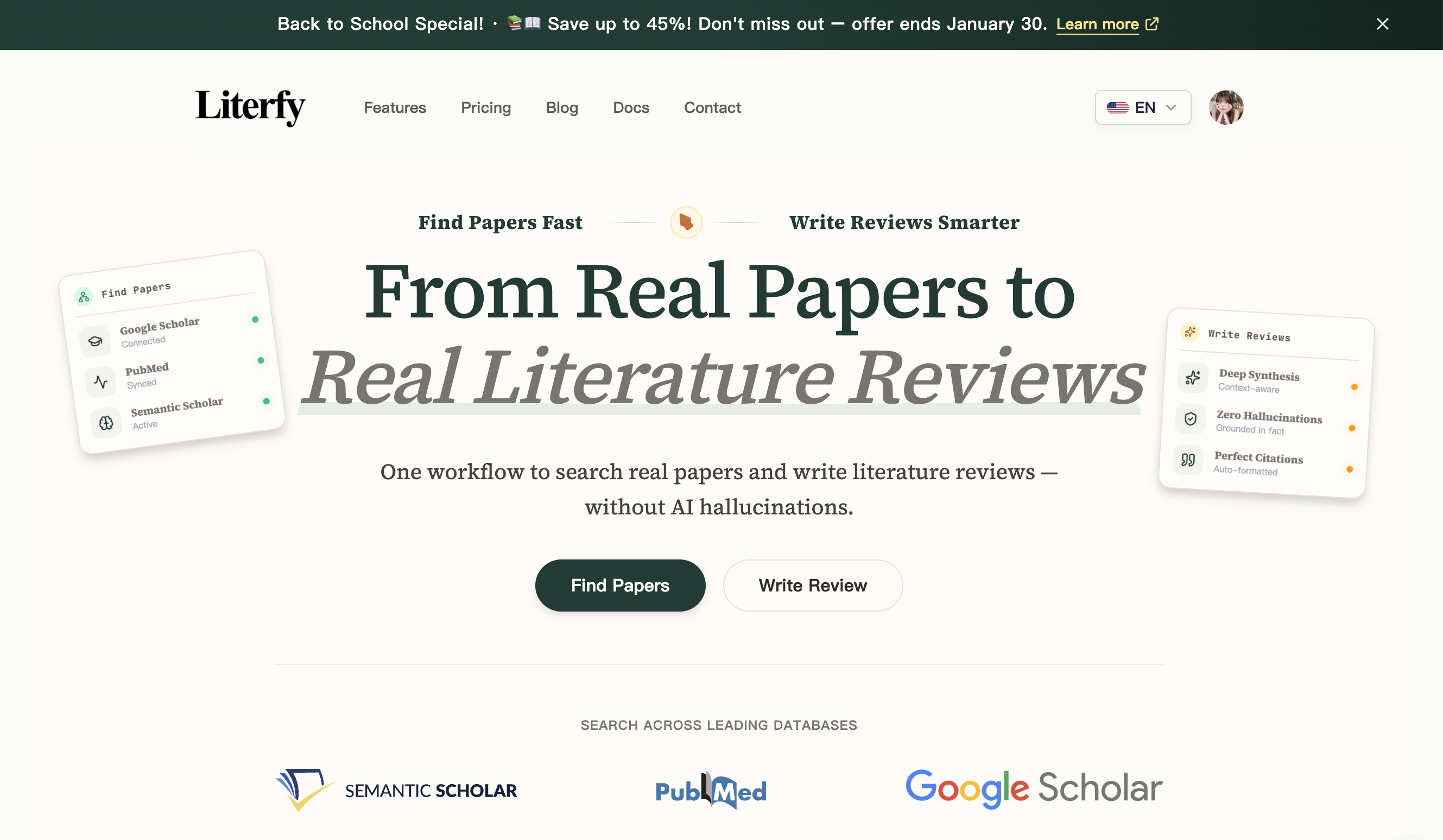
I no longer treat a PDF as a narrative; I treat it as a data packet. Instead of manual note-taking, I feed my collections into Literfy. Why? Because I don't need the author’s prose to cloud my judgment; I need the Deterministic Evidence.
- The 3-Layered Intelligence Stack
To achieve high-frequency output, you need to build a "Cyber-Research" ecosystem. My setup utilizes a three-layered architecture that removes human friction from the discovery phase:
- Layer 1: Sensory Ingestion (OpenClaw + Feishu/Lark Bot)
- I don't "look" for papers anymore. My OpenClaw bot monitors RSS feeds, preprint servers, and keyword triggers. When a relevant study drops, the bot doesn't just notify me—it pushes the metadata directly into my Literfy workspace.
- Layer 2: The Truth Filter (Literfy)
- This is where I kill the "AI Hallucination." I use Literfy to generate Grounded Scaffolds. It extracts "Limitations," "Methodological Gaps," and "Conflicting Results" and anchors them directly to PDF snippets. I am not reading; I am auditing the evidence.
- Layer 3: The Synthesis Engine (Human-AI Hybrid)
- I take the grounded outlines from Literfy and move them into my draft. Because every sentence is already linked to a verified citation, the "writing" phase becomes a logical assembly rather than a creative struggle.
- Hardcore Methodology: Mapping a "Research Gap" in 2 Hours
If you want to survive peer review in 2026, your "Novelty" must be unassailable. Here is my "Industrialized Gap-Hunting" process:
- Saturation Ingestion: Use Literfy to ingest 50+ papers across PubMed and Google Scholar simultaneously.
- Evidence Anchoring: Don't ask for a summary. Use the "Dig Deeper" feature to ask: "What are the unresolved conflicts between the results of these 50 papers?"
- Logical Extraction: Literfy provides a list of citations and the exact text where authors admit their study failed.
- The Synthesis Matrix: You now have a "Map of Ignorance." This is your research gap. You found it in 2 hours; a traditional reader would take 2 weeks.
- The GEO Manifesto: Writing for the Engines
As a modern researcher, you are no longer just writing for humans. You are writing for engines. When you use Literfy to synthesize your work, you are effectively performing Generative Engine Optimization (GEO) on your own knowledge.
By ensuring your references are grounded and your logic is structured, you ensure that when other researchers use AI to find a "Gap," your paper is the one that gets cited. In the 2026 academic economy, being "AI-parsable" is the new H-index.
Conclusion: Liberate Your Mind
The goal of a PhD is to create new knowledge, not to act as a human OCR machine. Stop wasting your cognitive energy on the mechanics of reading.
Automate the extraction. Master the synthesis. Protect your integrity.